Mitaki-dera:
three waterfalls, twenty minutes out.
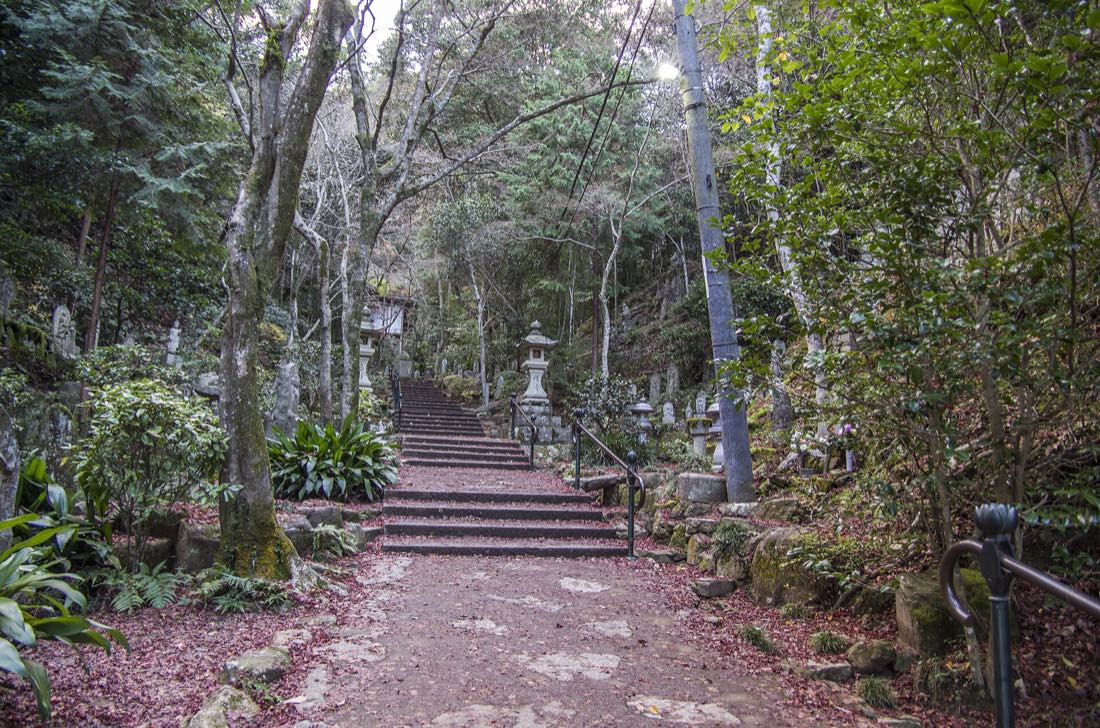
A mossy hillside temple with three waterfalls, a vermilion pagoda brought here in 1951 for the bomb's dead, and almost nobody on the path. TripAdvisor's users rank it ninth in Hiroshima. No English listicle ranks it at all.
The best free 90 minutes in Hiroshima, travel included. Mitaki-dera is a wooded hillside temple in the north-west of the city — three waterfalls, moss, stone lanterns, a vermilion two-storey pagoda, and a path that keeps climbing. It costs nothing, it takes about 90 minutes door to door from the centre, and unlike almost everything else in this city it is better in rain and outstanding in the second half of November.
Ninth on TripAdvisor. Absent from every list.
The gapThis is the clearest example on the whole site of the difference between what visitors rate and what publishers rank.
Mitaki-dera sits ninth on TripAdvisor's ranking of things to do in Hiroshima — a list built from the reviews of people who actually went. It appears on essentially none of the English editorial lists that rank on Google for this city. The reason is not that it is bad. The reason is that it is 20 minutes off the tram network, hard to photograph in a single hero image, and not on the standard park-castle-island axis that every guide copies from every other guide.
So you get the inverse of the usual tourist problem. The crowd is at a castle whose keep closed on 22 March 2026, and the temple that people rate ninth has a handful of visitors on a weekday morning and a path you can have to yourself. Hiroshima is a comfortable, well-run, entirely ordinary mid-size Japanese city. The bomb took the old fabric and the rebuild was practical rather than picturesque. Come for the Peace Park, the island and the food — not for the streetscapes. The mistake almost everyone makes is giving the important part four hours and the ordinary part none.
The temple was founded in 809 and takes its name — 三滝, "three waterfalls" — from the streams that fall through the site. Water drawn from them is carried down to the Peace Memorial Park each 6 August and offered at the Cenotaph, for the dead who died asking for water. The two-storey pagoda near the main hall is not original to the site: it was moved here from Wakayama Prefecture in 1951 to console the souls of the bomb's victims. None of this is signposted in English at any length, and it is why the place lands differently after the museum than before it.
When Mitaki-dera is at its best
By monthOne of the few places in Hiroshima where the wrong weather is not a problem.
Hiroshima oysters are a winter dish — roughly October to March, peaking December to February. Come in July and you'll find the farmed summer Kaki Komachi variety and a lot of restaurants simply not doing oysters. The grilled-oyster stalls and the festivals are a November-to-March thing.
Mitaki-dera against the other outdoor half-hours
ComparedThe question this table answers: you have two spare hours and it is drizzling. Where do you go?
| Option | Price | Door to door | In rain | In late November | Verdict |
|---|---|---|---|---|---|
| Mitaki-dera | Free | 90 min | Better — moss and full falls | Outstanding — maple | WORTH IT |
| Shukkeien Garden | ¥350 ($2.22) | 60 min | Poor — no cover | Excellent | WORTH IT |
| Castle grounds | Free | 60 min | Poor | Fair | DEPENDS |
| Momijidani Park, Miyajima | Free + ferry | Half a day | No — the crossing is wasted | Outstanding, and packed | DEPENDS |
| Hondori arcade | Free | 30 min | Best in the city — roofed | Irrelevant | DEPENDS |
| An art museum | Not verified | 90 min | Good — indoors | Fine | DEPENDS |
Mitaki-dera is the only outdoor option in Hiroshima that a wet forecast improves. Wear shoes with grip — the stone steps are mossy, and that is the whole point of them.
Mitaki-dera, practically
Plan your visitGuided, or on two wheels
Book itThe temple is easy to reach and hard to read — nothing on the site explains the pagoda or the 6 August water in English. We do not republish tour prices, ratings or review counts.
Mitaki-dera — common questions
FAQPage schema pairedIs Mitaki-dera free?
It is consistently reported as free and there is no ticket office, though we have not verified the absence of a fee on site. Carry a few ¥100 coins for the offering boxes. Budget ¥0 for entry and the JR fare to Mitaki station for transport.
How do you get to Mitaki-dera from Hiroshima Station?
JR Kabe line to Mitaki, about 10 minutes, then roughly 15 minutes on foot uphill through a residential street to the gate. The Hiroden streetcar does not go there, so the flat ¥240 ($1.52) tram fare does not apply — see getting around.
How long do you need at Mitaki-dera?
45 to 60 minutes on the site to walk up past all three waterfalls and back, and about 90 minutes door to door from central Hiroshima. Add 20 minutes in late November, when you will keep stopping.
Is Mitaki-dera worth visiting?
Yes — it is the best free 90 minutes in the city and it sits ninth on TripAdvisor's Hiroshima ranking while appearing on no editorial list. Skip it only if you have under a day here, in which case the Peace Park takes everything.
What is there to do in Hiroshima when it rains?
Mitaki-dera is the one outdoor answer — moss, mist and full waterfalls make a wet day better rather than worse, for ¥0. Everything else indoors is on the rainy-day page: the museum at ¥200, the arcades, an okonomiyaki counter and the art museums at ¥2,500, ¥510 and ¥350.
When is the best time to visit Mitaki-dera?
The second half of November for maple — late November to early December is the best weather-versus-crowds window of the whole year in Hiroshima — and tsuyu, roughly 6 June to 19 July, for water and moss with nobody there. Avoid an August afternoon: the average daily maximum is 32.8°C, the overnight low averages 25.1°C, and this is a climb.
Is Mitaki-dera accessible?
No. The approach is a continuous climb on uneven stone steps and tree roots, and it is slippery in wet weather. Shukkeien at ¥350 is the flat alternative, and the castle grounds are broadly level gravel.
Why is Mitaki-dera not on the usual Hiroshima lists?
Because editorial lists rank the park-castle-island axis and copy each other. Mitaki-dera is 20 minutes off the tram network and does not photograph as a single hero shot, so it drops out — while a keep that closed permanently in March 2026 stays in the top three. Ranked by the people who actually went, it is ninth.