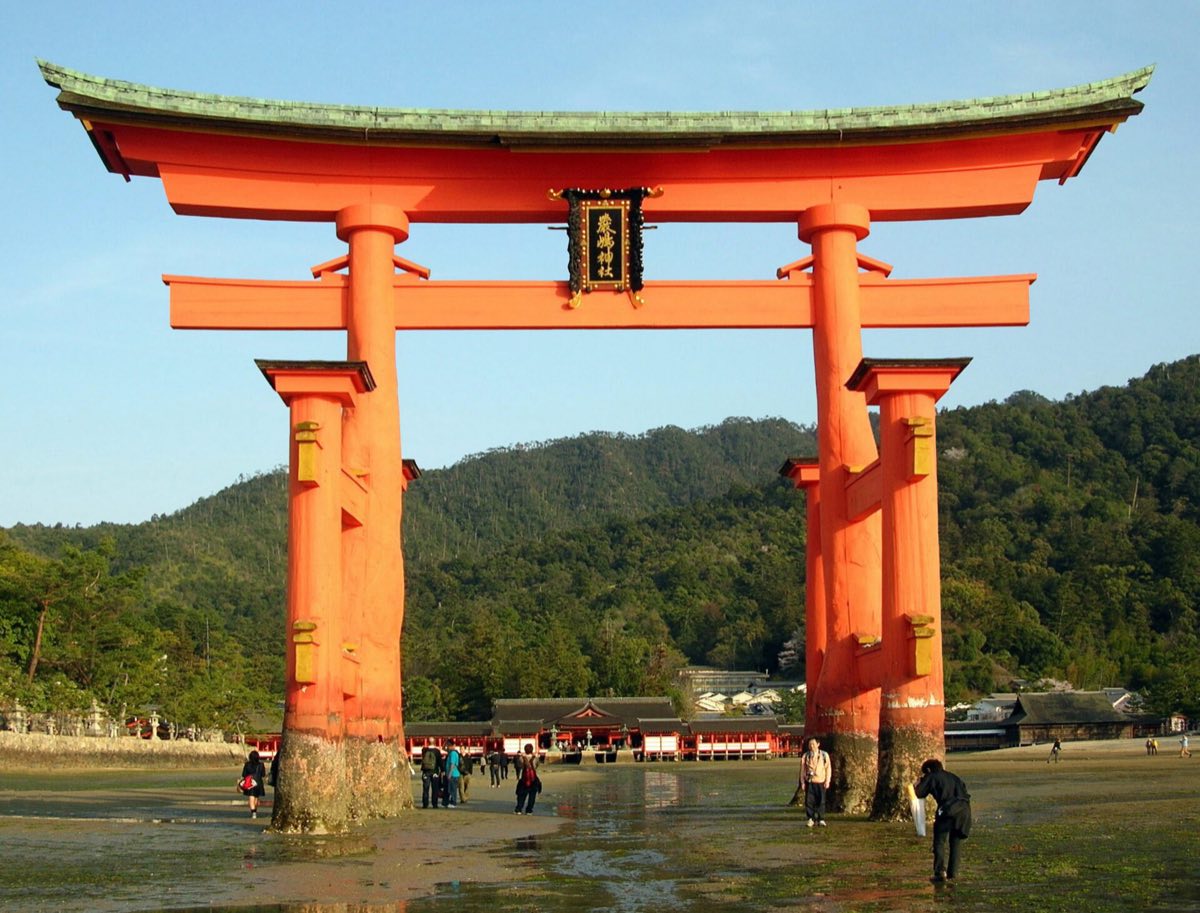
Miyajima tide times:
the float is nearly
every day. The walk
is not.
The Great Torii is a different object at every tide height, and the most common Miyajima disappointment is arriving at the wrong one. Above 250cm it appears to float — available essentially every day of the year, for about seven hours a day. Below 100cm you walk out across the sand and stand under it — and that only happened on 106 of the 153 days between August and December 2026.
Do both. The two states are about six hours apart, and on 25 of 30 August days and 16 of 30 November days in 2026 both thresholds were crossed in daylight — so a full island day gets you the floating gate and the walk out to it. If you can only have one, take the high tide: above 250cm the torii floats and the shrine's corridors stand over water, and that state is available essentially every day of the year for around seven hours. The walk is the scarce one. Look your date up in the Miyajima Tourist Association's own table, which computes both windows for you.
What you get at every tide height
Time it rightRead your date in the official table, find the height for the hour you would arrive, and match it to a band below. The 100cm and 250cm thresholds are printed on the Miyajima Tourist Association's own tide table — they are not our estimate. One warning that decides whether the numbers mean anything: they are measured against the Hiroshima Port tidal datum, 200.0cm below mean sea level, so a generic tide app on a different datum returns figures that look similar and are not comparable. Use the association's table or JMA station Q8.
Look your date up in the official table below, then type the height for the hour you would arrive.
The photograph. The 16m gate stands in open water and appears to float, and at the top of the range small boats run out to it. This is the image every Hiroshima article uses.
| Tide height | What you get | The shrine corridor | Best for | Verdict |
|---|---|---|---|---|
| Under 100 cm WALK OUT | The sand is exposed and you can walk out to the Great Torii, stand under it and touch the legs. Between 100 and about 120cm you can get close with wet feet; for dry shoes and a wide sand flat you want about 40cm or lower. This is tidal flat, not beach. | Sits over wet sand. The corridors still work as architecture, but there is no reflection and no water underneath. | Families, anyone who wants to be photographed under the gate, and second visits. | DEPENDS |
| 100–250 cm NEITHER | The band nobody warns you about. Too much water to walk out, too little to float anything — wet sand, shallow puddles, no reflection, and a gate you can neither reach nor photograph properly. | Water is under part of the structure at best. The famous mirror-image shot is not available at any point in this range. | Nobody. If your only possible arrival lands here, either shift the sailing by two hours or plan the day around Mount Misen and Daisho-in instead. | SKIP |
| Over 250 cm IT FLOATS | The photograph. The 16m gate stands in open water and appears to float, and at the top of the range small boats run out to it. This is the image every Hiroshima article uses. | The shrine's corridors and stage stand over water — which is the entire architectural point of the building, and the reason it is a UNESCO site. | First-time visitors, photographers, and anyone who has one shot at the island. | WORTH IT |
The Miyajima Tourist Association publishes the island's own table by date, in centimetres, hour by hour, and marks the walk and float windows for you — use it rather than a generic tide app, because these heights are referenced to the Hiroshima Port datum 200.0cm below mean sea level and are not interchangeable with figures on another datum. The mechanism worth understanding: 250cm sits well below a typical 330–385cm high, so the float clears for hours on almost any day; 100cm sits near or below a typical low, so on a neap tide — as little as 1.4m of range against 3.5–3.8m at springs — the water never reaches it. Neaps kill the walk. They never kill the float.
What the 2026 tide table actually allows
Our own countWe read every day from August to December 2026 off the official table. Nobody else publishes this, and it reverses the advice most Miyajima articles give.
Book the ferry around the tide, not the other way round
How to actually use thisMiyajima runs on the tide, not the clock. Above 250cm the Great Torii appears to float and the shrine's corridors stand over water; below 100cm you can walk out across the sand to the gate's legs. Those are the Miyajima Tourist Association's own published thresholds, and they are measured against the Hiroshima Port datum — 200cm below mean sea level — so a generic tide app will give you numbers that look similar and are not comparable. Check the official table before you book the ferry, not after.
The mechanics are simple. Open the tide table, find your date, and read across the hours. You are looking for a block above 250cm or below 100cm, and then you plan the ferry to land inside it. Sailings run every 15 minutes or so from Miyajimaguchi and the crossing takes 10 minutes, so a shift of two hours costs you nothing but scheduling — the routes and fares are here.
The verdict to plan around: do both on the same day. On 25 of 30 August days and 16 of 30 November days in 2026, both thresholds were crossed in daylight. That is a six-hour island day, which is what Miyajima deserves anyway: shrine and torii at high water, Daisho-in and Mount Misen in the middle, and the walk out to the gate's legs when the water has gone. Almost nobody plans it that way and it is the best version of the day.
Check for the dead stretches. From 20 to 24 August 2026 the tide never dropped below 100cm at any hour — the lows were 108, 125, 138, 130 and 111cm. A visitor arriving on 21 August cannot walk to the torii at all, no matter what time they take the ferry, and no article we can find warns them. That happens because 100cm sits near or below a typical low: on a neap, with as little as 1.4m of range against 3.5–3.8m at springs, the water simply never gets there.
The classic disappointment runs the other way too. A visitor lands at 11:00 on a 60cm tide expecting the floating gate from the brochure, finds it standing on mud behind a crowd of people walking out to it, takes a picture that looks like nothing, and leaves. Five minutes with the tide table prevents it.
One more thing the tide does not control: the illumination. The Great Torii and the shrine exterior come on 30 minutes after sunset and stay lit until 23:00, year-round — so the start drifts from about 19:30 at midsummer to about 17:35 in December, and you should look up sunset for your date. You cannot go inside the shrine during the illumination. It closes at 18:00 and the lit view is from outside: the Omotesandō shore, Mikasanohama, or a boat. Any article implying an evening stroll through the corridors is wrong. The last JR ferry off the island is 22:14, so you can see it and leave — but the 06:30 morning still needs an island bed.
Three boats, and the one that goes under the gate
On the waterTwo of these are tide-dependent in opposite directions, which is the detail that makes them worth a table.
| Boat | Price | When | Notes | Verdict |
|---|---|---|---|---|
| Rokaibune — the oared boat under the torii | ¥1,500 adult · ¥500 child | High tide only, roughly 10:00–15:00, about March–November | 20–30 minutes, no reservations — queue on the day. ⚠ Some sites still print ¥1,000; that figure is stale | WORTH IT |
| Aqua Net night cruise (大鳥居遊覧船) | ¥2,000 adult · ¥1,000 child | Six sailings 17:55–21:15 | About 25 minutes from Miyajima Pier 3. Book 2 hours ahead, cash only. The best way to see the illumination | WORTH IT |
| World Heritage Sea Route — Peace Park to Miyajima | ¥2,400 one way · ¥4,400 return | Daily, about 45 minutes | Reserve by the previous day. Covered by no pass. Compare with ¥620 by tram and ferry | DEPENDS |
The paradox worth planning around: the rokaibune needs a high tide, so it runs at exactly the hours you cannot walk out to the gate. If both matter to you, take the boat under the torii at high water and come back for the walk six hours later — which is the same argument as doing both states in one day.
High tide or low tide — what each one costs you
Head to headIf your schedule only allows one, this is the trade.
| High tide (above ~250cm) | Low tide (below ~100cm) | |
|---|---|---|
| The torii | Appears to float in open water | Stands on exposed sand; you walk out to it |
| The photograph | The classic shot, with reflection | Poor — a gate on mud with people around the legs |
| The shrine corridors | Over water, as designed | Over wet sand |
| Can you touch the gate? | No | Yes — you can stand under all 16m of it |
| Crowds at the gate | Concentrated on the shrine boardwalk | Spread across the flats, but everyone walks out |
| Footwear | Anything | Shoes you can rinse — it is tidal mud |
| Best for | First visit, photographers, one-shot itineraries | Families, repeat visits, anyone who wants the novelty |
| Verdict | WORTH IT | DEPENDS |
If you can only pick one, pick high tide. The floating gate is what you came for; walking out to it is the better story but the weaker photograph, and it is available on most days at some point.
When the island is busy, whatever the tide is doing
Hour by hourTide and crowd are separate problems. Even a perfect 280cm tide is a queue at 11:00.
Independent early arrivals. Still comfortable, and the light is good on the gate.
Timing the island
Plan your visitIt is a different day.
Nothing above the waterline cares about the tide. Mount Misen, Daisho-in, Momijidani and the food street are all unaffected, and a 150cm arrival is a perfectly good excuse to spend the morning at 535m instead of on the boardwalk. Guided island walks and Misen hikes run whatever the water is doing — we do not publish their prices or ratings here because we could not verify them, so check the listing.
See Misen and island toursTide questions people actually type
FAQPage schema pairedWhat is the best tide for Miyajima?
Above 250cm for the floating torii, below 100cm to walk out to it — and on most days you can have both, six hours apart. If you only get one, take the high tide: the float is available essentially every day for about seven hours, while the walk happened on only 106 of 153 days between August and December 2026.
What time is high tide at Miyajima today?
It moves by roughly 50 minutes a day, so no fixed answer holds. Use the Miyajima Tourist Association's own table, which gives the day's heights in centimetres hour by hour and marks the walk and float windows. Do not substitute a generic tide app: these heights are measured against the Hiroshima Port datum, 200.0cm below mean sea level, and figures on another datum are not comparable.
Can you walk to the torii gate at low tide?
Yes, below 100cm — but not on every date. Between 100 and about 120cm you can get close with wet feet; for dry shoes and a wide sand flat you want about 40cm or lower. It takes about 5 minutes each way, it is free, and there is no time limit beyond the returning water. Wear shoes you can rinse: it is mud in places, with oyster shells.
Is high tide or low tide better for photos?
High tide, decisively. Above 250cm you get the gate in open water with a reflection; below 100cm you get a 16m wooden structure standing on brown flats with 200 people walking around its legs. The best light is the first hour after 06:30 or the illumination after sunset.
How long do the tides take to change at Miyajima?
About 6 hours between the useful states, which is the standard semi-diurnal cycle. A visitor landing at 09:00 on a 90cm tide can be looking at a floating gate by about 15:00. The float almost always clears, because 250cm sits well below a typical 330–385cm high; it is the 100cm walk threshold that fails on neap tides, when the range can be as little as 1.4m against 3.5–3.8m at springs.
Can I see the torii lit up at night?
Yes. The illumination comes on 30 minutes after sunset and runs to 23:00 year-round, so the start drifts from about 19:30 at midsummer to about 17:35 in December — look up sunset for your date. You cannot enter the shrine during it: the building closes at 18:00 and the lit view is from the Omotesandō shore, Mikasanohama or a boat. The last JR ferry off the island is 22:14.
Is Miyajima worth visiting at low tide?
Yes — but plan a different day. Daisho-in, Mount Misen, Momijidani and the food street do not care about the water, and walking under the gate is a genuine experience. What you lose is the one photograph, and you should know that before you spend ¥500 on the return ferry rather than after.
Where do the 100cm and 250cm thresholds come from?
They are printed on the Miyajima Tourist Association's own tide table, and we confirmed them independently twice — they are not an estimate. The number that matters alongside them is the datum: heights are referenced to Hiroshima Port, 200.0cm below mean sea level. Use the association's table or JMA station Q8, not a generic app.
Are there days when you cannot walk to the torii at all?
Yes, and this is the warning almost nobody publishes. From 20 to 24 August 2026 the tide never dropped below 100cm at any hour — lows of 108, 125, 138, 130 and 111cm — so a visitor arriving on 21 August cannot make the walk whatever time they sail. Neap tides do this several times a year; November 2026 allowed the walk on only 16 of 30 days.
Can I take a boat under the torii gate?
Yes — the rokaibune, an oared boat that passes beneath the gate, is ¥1,500 for adults and ¥500 for children, runs 20–30 minutes at high tide only between roughly 10:00 and 15:00, around March to November, with no reservations. Ignore the ¥1,000 figure still ranking on other sites. The paradox: it needs the high tide, so it runs exactly when you cannot walk out.