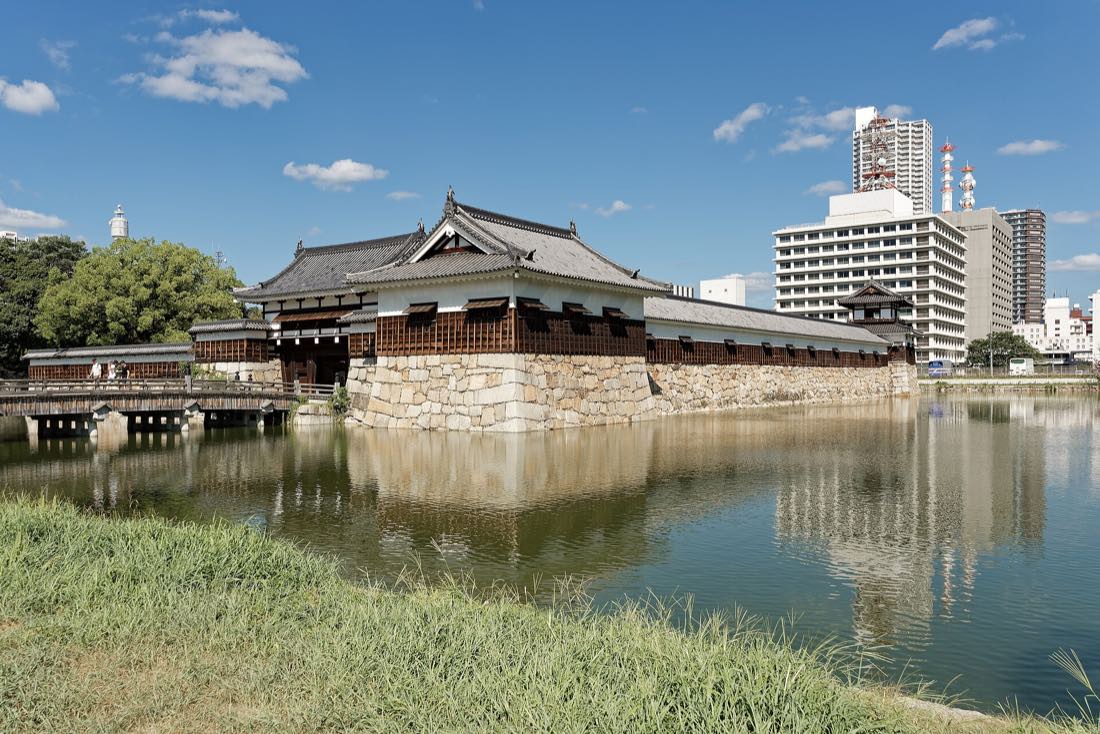
Hiroshima Castle:
the keep is closed. Permanently.
On 22 March 2026, after 68 years, the reconstructed keep closed to the public for good — it no longer meets earthquake standards. Three of the ten pages ranking for this city still tell you to climb it for the view. The grounds are open, free, and worth 45 minutes.
Go, but change what you are going for. The keep closed permanently on 22 March 2026, so there is no tower to climb and no admission to pay. What is still there is free and open daily 09:00–17:30 (to 16:30 October–March): the moat, the Ninomaru reconstruction, Gokoku Shrine, and the stone walls that carry the blast damage from 8:15 on 6 August 1945. Forty-five minutes, ¥0. If you came for the view, go to Orizuru Tower instead.
The keep closed on 22 March 2026, and it is not reopening
What happenedThis is not a renovation closure with a reopening date. The 1958 building is being taken out of service and replaced.
Hiroshima Castle's keep closed to the public on 22 March 2026 — after 68 years — because the 1958 reinforced-concrete reconstruction no longer met earthquake standards. A wooden rebuild is planned but years out. The grounds, the moat, the bomb-scarred stone walls and the Ninomaru reconstruction are all still open, and all still free. The tower you came to go inside is not.
The building that closed was a reinforced-concrete reconstruction from 1958, put up thirteen years after the original wooden keep was destroyed on 6 August 1945. It served for 68 years as the castle museum and took over 13 million visitors in that time. The final admission price before it shut was ¥370 ($2.35). The closure is confirmed by the City of Hiroshima, the castle's own notice and the national and local press — this is not a rumour.
It has not been demolished. The castle's own notice states that the exterior can still be viewed, and no demolition is scheduled. You can still stand in front of the keep and photograph it. You simply cannot go in, and there is nothing to buy a ticket for.
On what replaces it, be careful with dates. The collection is moving to the new Hiroshima Castle Sannomaru History Museum — Sannomaru, not Ninomaru — expected by March 2027, described as "spring 2027"; treat that as a target rather than a booking. The wooden reconstruction is a much softer thing than most reporting suggests: the city says explicitly that it has not been decided, and that policy follows further survey work. On the city's own estimate the earliest possible completion is FY2049. Anyone telling you the wooden keep is a few years away is guessing.
The practical consequence for a visitor in 2026 is simple and total: there is no interior, no museum display, no top-floor observation gallery and no ticket window at the keep. Everything else on the site is open, and all of it is free — and one thing on the site is brand new.
Sannomaru opened on 29 March 2026, and nobody has written about it
The new partA week after the keep closed, the castle gained a reason to visit that it did not have a year ago.
The Sannomaru (三の丸) quarter opened on 29 March 2026 at the south-west corner of the castle site, with five tenants: Sannomaru Hassho, an okonomiyaki shop in the Hassei lineage, an eel restaurant, a café, a local-products shop and a mini kyudo archery range. There are 24-hour toilets and a pedestrian deck through to Hiroshima Gate Park.
This matters more than it sounds. The old visit was 45 minutes of grounds plus a concrete tower; the new visit is 45 minutes of grounds plus somewhere to eat that is actually good. A Hassei-lineage counter inside the castle grounds is a legitimate lunch stop rather than a captive-audience concession — see the okonomiyaki page for what that lineage means and how the Hiroshima style differs from the other one.
So the sentence we would now write is: come for the walls, stay for lunch, and do not expect a tower. That is not the sentence any other page ranking for this castle is writing, because most of them have not noticed either event.
Three figures that decide this page
The numbersEvery other verdict below falls out of these.
What you can still see, and what you cannot
Open vs closedThe whole site in one table. Everything in the open column is free unless a price is shown.
| Part of the castle | Status in August 2026 | Price | Time | Worth stopping for? |
|---|---|---|---|---|
| Main keep (tenshu) — the five-storey tower in every photograph | Closed permanently, 22 March 2026. Not demolished — the exterior is still there to photograph | n/a — no ticket sold. It was ¥370 | 10 min from outside | SKIP |
| Top-floor observation gallery | Closed with the keep | n/a | 0 min | SKIP |
| Castle museum exhibits | Closed; moving to the Sannomaru History Museum, targeted by March 2027 — treat the date as a target | n/a | 0 min | SKIP |
| Sannomaru quarter — opened 29 March 2026: okonomiyaki, eel, café, local products, mini archery range | Open, and new | Free to enter; you pay for what you eat | 45–60 min | WORTH IT |
| Atomic-bomb-scarred stone walls | Open | Free | 15 min | WORTH IT |
| The moat and the outer walk | Open | Free | 15 min | WORTH IT |
| Ninomaru reconstruction — the rebuilt gate, turret and passage | Open, Apr–Sep 09:00–17:30 · Oct–Mar 09:00–16:30, last entry 30 min before. Closed 8 December and 29–31 December | Free | 15 min | WORTH IT |
| Gokoku Shrine, inside the walls | Open; the shrine office is staffed 09:00–16:30 | Free | 10 min | DEPENDS |
| Hokoku Shrine | Open 08:30–16:30 | ¥100 ($0.63) | 10 min | DEPENDS |
| The eucalyptus and willow A-bomb survivor trees | Open | Free | 5 min | WORTH IT |
| A view over the city | Gone — it was the keep's | Orizuru Tower is now the city's main paid viewpoint: ¥2,200 + ¥100 crane fee | 45 min there | DEPENDS |
Grounds hours are 09:00–17:30, closing 16:30 from October to March. The open ground and the moat path are walkable outside those hours; the Ninomaru buildings are not, and they also close on 8 December.
Almost every page ranking for this castle was written before it shut
Say it plainlyWe are not being coy about this, because it is the single most useful sentence on the site.
In August 2026, three of the ten pages on Google's first page for this city still instruct readers to go up Hiroshima Castle for the view. Several quote an admission price. None of them mentions 22 March 2026. A reader following that advice walks 15 minutes from the Peace Park to a building they cannot enter, having budgeted a fee that no longer exists.
The clearest illustration is a major Japan guide whose own castle sub-page states that the keep is closed — while its things to do in Hiroshima ranking page, which is what actually ranks and what people actually read, does not. The correction exists on that site. It has not reached the page carrying the traffic. That is the gap this site is built in.
If you have already booked a tour that lists "Hiroshima Castle" as a stop, it is not necessarily wasted — the grounds walk is a legitimate 45 minutes and several city walking tours were always ground-level. But ask the operator what they now do at that stop, and do not accept an itinerary that promises the keep interior.
Where the castle's view went, and what to give the time to
What to do insteadFor the view: Orizuru Tower, beside the A-Bomb Dome. With the keep shut it is now the city's main paid viewpoint, and this is the question nobody is answering: ¥2,200 ($13.95) adult, ¥1,400 junior and senior high, ¥900 elementary, ¥600 from age 4, plus a ¥100 paper-crane fee. Open 10:00–18:00, last entry 17:30, with unlimited same-day re-entry. One honest caveat before you spend ¥2,200: safety mesh crosses the glass and spoils most photographs.
For a garden: Shukkeien is ¥350 ($2.22) — free if you are 65+ with ID or in high school or under — and about ten minutes' walk east of the castle. The ¥660 combined ticket with the Prefectural Art Museum next door saves ¥200 and is the natural wet-weather pairing.
For the history the keep used to carry: the castle was the headquarters of the Imperial Army's Fifth Division and a military nerve centre — which is part of why the city was a target. That thread runs through the Peace Memorial Museum, twenty minutes' walk south, and it is better told there than it was in the tower.
For a free hour instead: the free list has the new Teishin Hospital annex, which opened on 1 May 2026, the 13:00 English testimony talk, and the riverbanks.
Hiroshima is a comfortable, well-run, entirely ordinary mid-size Japanese city. The bomb took the old fabric and the rebuild was practical rather than picturesque. Come for the Peace Park, the island and the food — not for the streetscapes. The mistake almost everyone makes is giving the important part four hours and the ordinary part none.
Hiroshima Castle, practically
Plan your visitTours that include the castle grounds
Booking and getting thereAll of these were ground-level walks before the closure, so none of them loses its main stop. We do not republish tour prices, ratings or review counts — open the link for the live figure.
Hiroshima Castle — the questions people are typing right now
FAQPage schema pairedIs Hiroshima Castle closed?
The main keep is closed permanently, from 22 March 2026, after 68 years — but it has not been demolished, and the castle's own notice says the exterior can still be viewed, so the photograph is still available from outside. The grounds, moat, stone walls, Ninomaru reconstruction, Gokoku Shrine and Hokoku Shrine are all open. Grounds hours are 09:00–17:30, closing 16:30 from October to March, and Ninomaru also closes on 8 December.
Why did Hiroshima Castle close?
The keep you could enter was a 1958 reinforced-concrete reconstruction, and it no longer meets Japan's earthquake standards. A wooden rebuild is discussed, but the city says it has not been decided and that policy follows further survey work — and its own earliest possible completion estimate is FY2049. Anyone quoting 2029 is guessing.
How much does Hiroshima Castle cost now?
Nothing. There is no ticket window, because there is nothing ticketed to enter — the final admission price before closing was ¥370 ($2.35). The only charge left on the site is ¥100 ($0.63) at Hokoku Shrine, 08:30–16:30. Budget ¥0, or the cost of lunch at the new Sannomaru quarter.
Is Hiroshima Castle worth visiting in 2026?
More than it was in April. The Sannomaru quarter opened on 29 March 2026 with five tenants including a Hassei-lineage okonomiyaki shop, an eel restaurant and a mini archery range, so the site now has a lunch stop as well as a walk. Go if you are within ten minutes of the moat; do not cross town for it, and do not expect a tower.
What is the Sannomaru quarter at Hiroshima Castle?
A new commercial quarter at the castle that opened on 29 March 2026, a week after the keep closed: five tenants — okonomiyaki in the Hassei lineage, an eel restaurant, a café, a local-products shop and a mini kyudo archery range — plus 24-hour toilets and a pedestrian deck to Hiroshima Gate Park. It is separate from the Sannomaru History Museum, which will house the castle's collection and is targeted by March 2027.
How do you get to Hiroshima Castle from Hiroshima Station?
Hiroden line 1, 2 or 6 to Kamiyacho-nishi, about 12 minutes, then roughly 12 minutes on foot north. The flat fare is ¥240 ($1.52). The Meipuru-pu loop bus also stops at the castle, takes a little longer and is covered by the JR Pass — see getting around.
When will Hiroshima Castle reopen?
The 1958 building is not reopening at all. A wooden reconstruction has not been decided by the city, and its own earliest possible completion estimate is FY2049. The castle's collection is moving to the new Sannomaru History Museum, targeted by March 2027 — treat that as a target, not a date to plan around.
Is the castle worth it with kids?
Better than it was. The grounds are fine for a 30-minute run-around, the moat carp hold small children, and the new Sannomaru quarter has food and a mini archery range. What is gone is climbing a castle. On a family day a Carp game or Miyajima still earns the time better — see Hiroshima with kids.