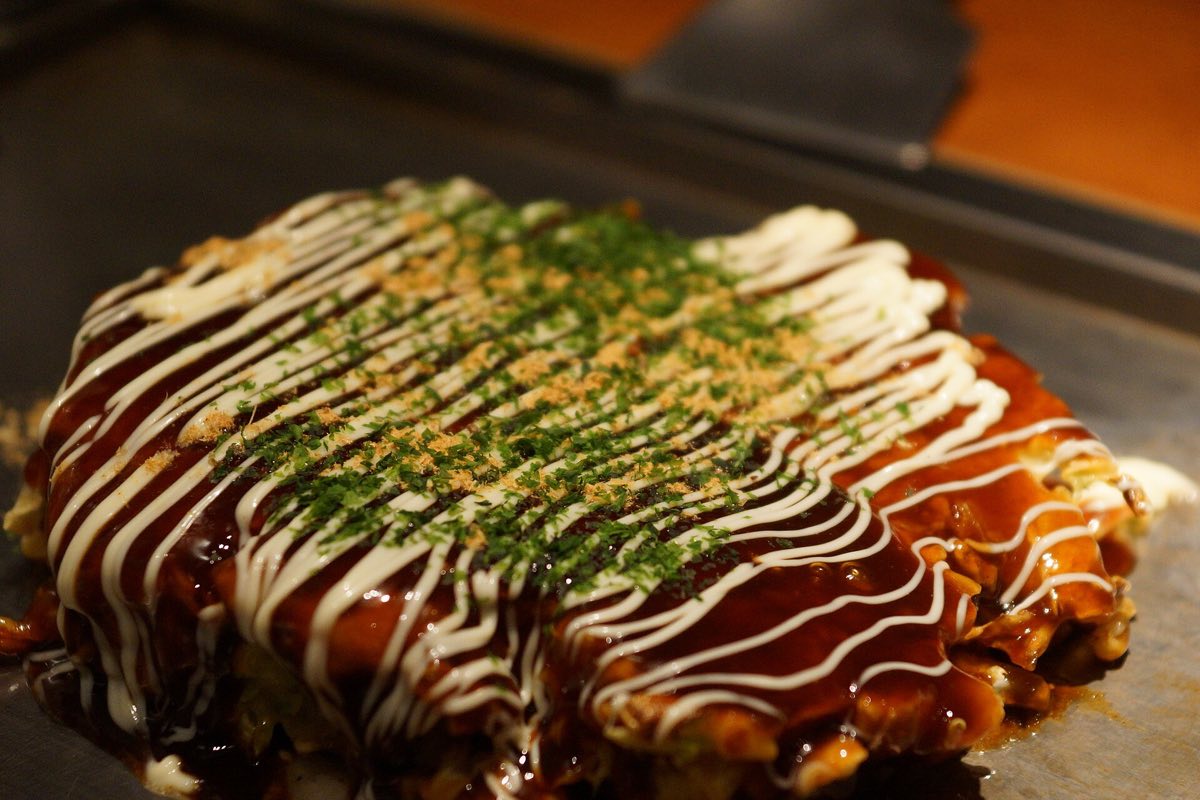
Hiroshima okonomiyaki is
layered, not mixed
— and it has noodles in it
One sentence separates this dish from the version most visitors have already eaten elsewhere: nothing is stirred together, and a nest of fried noodles goes in. Everything else — the cabbage mountain, the flip, the spatula you eat it with — follows from that.
Eat it at a single standalone counter rather than in the stacked-stall tourist building. Sit at the teppan, watch the five layers go down in order, and eat it off the hot plate with the metal spatula. Micchan Sōhonten's own menu prices the standard soba or udon build at ¥960 (about $6); Nagataya sits in a ¥1,000–1,999 band. Both close on Tuesdays and neither takes reservations. Cooking takes about 15–20 minutes and the dish is on all year, unlike the oysters.
What Hiroshima okonomiyaki actually is
Answer firstA savoury griddle dish assembled in layers on a teppan, containing fried noodles, and never stirred. The cook spreads a thin crêpe of batter, piles on a mountain of finely shredded cabbage that looks like far too much, lays pork belly over it, flips the whole pile so the crêpe becomes a lid and the cabbage steams under it and compresses, crisps a separate nest of noodles alongside, stacks the pile onto them, fries an egg as a flat sheet and lands everything on top of it. Sauce goes on last.
The difference from the other major style is structural, not about ingredients — this is the framing Otafuku, the Hiroshima sauce maker, uses. The Kansai version is a mixture: cabbage stirred through the batter and cooked as one pancake. Hiroshima is a stack: batter used only as a thin crêpe with nothing mixed into it, cabbage mounded on top, noodles as a standard layer rather than the optional modanyaki add-on, egg fried separately as its own sheet. The result is denser, taller and visibly stratified when you cut into it.
You eat it straight off the hot plate with a hera, the small metal spatula set in front of you, cutting a wedge and lifting it to your mouth, from a counter seat. Asking for a plate and chopsticks is not an offence, but the spatula is the local method and the dish stays hot on the griddle, which is the point.
Five layers, in this order, every time
The buildThe crêpe
A ladle of thin batter spread into a disc roughly 20cm across — closer to a pancake skin than a batter body. This is structural, not a flavour component. In Hiroshima it is the only batter in the dish.
The cabbage mountain
A pile of finely shredded cabbage that visibly does not fit, often with bean sprouts and a scatter of tenkasu (fried tempura scraps). It collapses to a fraction of its height as it steams under the pork. If it does not look absurd going on, you are in the wrong style of restaurant.
The pork
Two or three strips of thin pork belly laid over the cabbage. They render down into it and effectively steam the pile from above. This is also the layer that makes the standard dish impossible for vegetarians — see the vegetarian page for what to ask for instead.
The noodles
Yakisoba or udon, crisped separately on the griddle in the same sauce, then used as the base the cabbage stack gets moved on top of. Micchan Sōhonten prices そば肉玉子 and うどん肉玉子 identically at ¥960 — which is the detail that proves the point: soba or udon is a genuine either/or, not an upcharge. Soba is the default and crisps harder; udon is softer and chewier. This layer is why Hiroshima okonomiyaki is a meal rather than a snack.
The egg, then the sauce
An egg fried as a flat sheet on the griddle, the whole stack landed on top of it, then thick sweet-savoury okonomiyaki sauce brushed over. Nagataya publicly uses Otafuku sauce and Isono-men noodles, both local brands, which is the level of specificity this city applies to the dish. Bonito flakes, seaweed powder and spring onion go on at the counter. First ladle to spatula is usually 15–20 minutes.
Hiroshima style against the other style
ComparedIf you have eaten okonomiyaki in Osaka, this is what changes.
| Hiroshima style | The mixed (Kansai) style | |
|---|---|---|
| Assembly | Layered — batter, cabbage, pork, noodles, egg, in a fixed order | Mixed — cabbage stirred through the batter, cooked as one pancake |
| Noodles | Always included as their own layer | Optional add-on (modan-yaki) |
| Batter | One thin crêpe, structural only | A batter body throughout the dish |
| Who cooks it | Almost always the cook, at a counter teppan | Often you, at a table griddle |
| Eating it | Off the hot plate with a metal spatula | Plate and chopsticks are normal |
| Size | A full meal — the noodles see to that | Snack to meal depending on order |
| Cook time | About 15–20 minutes | Usually shorter |
| Price, verified | ¥960 standard at Micchan Sōhonten (~$6) | n/a — different city |
The ¥960 figure is taken from Micchan Sōhonten's own menu: そば肉玉子 and うどん肉玉子 both ¥960, special (squid and shrimp) ¥1,500, with oysters ¥1,840, 特製スペシャル ¥1,830, DX ¥2,030. Dollar prices convert at ¥157.7 = $1, the rate on 4 August 2026. Treat every $ figure as a snapshot and the ¥ figure as the real price.
Skip the building, keep the dish
The verdict that mattersThe instinct every guide encourages is to go to Okonomimura, the building with 23 okonomiyaki stalls stacked across floors 2 to 4. It is a genuine Hiroshima institution and it is also the most touristed okonomiyaki in the city — it scores 4.1 on TripAdvisor from 1,058 reviews, the weakest of the major sights every listicle pushes hardest, and one of those reviews is titled simply "Okonomimura: Tourist trap".
Our verdict is to separate the two decisions. The dish is unambiguously worth eating. The building is a spectacle worth 45 minutes if the stacked-stall thing appeals to you, and an average way to eat the dish if it does not. Go to a standalone counter — one shop, one griddle, one cook, a row of counter seats — and you get the version the city actually eats.
Micchan Sōhonten, Hatchōbori. The lineage shop, widely credited as the originator of the Hiroshima style. Standard そば肉玉子 or うどん肉玉子 ¥960, squid-and-shrimp special ¥1,500, oyster version ¥1,840, DX ¥2,030 — from the restaurant's own menu. Open Mon and Wed–Fri 11:30–14:30 and 17:30–21:00; Sat, Sun and holidays 11:00–14:30 and 17:00–21:00. Closed Tuesdays. Walk-in only, no reservations. ⚠ Its own site dates the business to 1925 while Tabelog says 1950; we flag the conflict rather than pick a side. There are branches inside Hiroshima Station (ekie) and at Orizuru Tower — the practical picks if you are on a rail schedule.
Nagataya, by the Peace Park. Roughly 10 seconds' walk from Peace Memorial Park and 2 minutes from the Genbaku Dome-mae tram stop, 52 seats, price band ¥1,000–1,999. Open from 11:00 with last orders around 20:00 — don't arrive after 19:30. Closed Tuesdays, and also 12–14 August for Obon. Walk-in only. ⚠ The "¥680 okonomiyaki" figure circulating on blogs is stale; use the ¥1,000–2,000 band. It uses Otafuku sauce and Isono-men noodles.
Hassei is the third name locals repeat, and it now has a branch in the new Sannomaru quarter at Hiroshima Castle, opened 29 March 2026 — which makes it the easy pairing with a castle-grounds morning. And Lopez (ロペス) is the cult pick: Guatemalan-run, with a tortilla-influenced handmade crêpe base instead of the standard batter. Prices and hours for Hassei and Lopez are unverified — names only.
One practical note that saves an evening: Tuesday is the closing day at both Micchan and Nagataya. If your one free night is a Tuesday, go to the Okonomimura stalls or the ekie Okonomiyaki-dōri inside Hiroshima Station instead. Otherwise eat early — 17:30 to 18:00 — or after 20:00, because the good counters queue at 19:00.
The practical bit
Plan your visitThe three counters, on TripAdvisor
Check before you walkHours and closing days move and small Hiroshima counters do not always announce it. These are the current listings for the three shops named above — worth a 30-second check the night before, particularly for the Tuesday closures.
Cook it, or be taken to it
Book itA cooking class is the only way to actually learn the layer order with your own hands, and a guided walk is the fastest way into counters with no English menu. We do not publish tour prices, star ratings or review counts on this site — none could be verified for this build. Check the live pages.
Is a counter seat right for you?
Who it suitsOkonomiyaki questions, answered
FAQPage schema pairedWhat is Hiroshima okonomiyaki?
A layered savoury griddle dish: a thin batter crêpe, a mountain of shredded cabbage, pork belly, a separate nest of fried noodles and an egg, stacked in that order and finished with sweet-savoury sauce. 5 layers, never stirred together. It takes about 15–20 minutes on the teppan and is served to you on the hot plate with a metal spatula.
Hiroshima okonomiyaki vs the other style — what is the difference?
It is structural, not a matter of ingredients. The Kansai version is a mixture — cabbage stirred through the batter, cooked as 1 pancake. Hiroshima is a stack: batter used only as a thin crêpe with nothing mixed in, a mound of shredded cabbage steamed under it, and noodles as a standard layer rather than an optional extra. The result is denser, taller and visibly stratified when you cut it.
Where should I eat okonomiyaki in Hiroshima?
At a standalone counter. Micchan Sōhonten in Hatchōbori is the lineage shop — ¥960 for the standard build, closed Tuesdays, walk-in only. Nagataya is about 10 seconds from Peace Memorial Park, ¥1,000–1,999, also closed Tuesdays and 12–14 August. Hassei is the third name and now has a branch at Hiroshima Castle's Sannomaru quarter, open since 29 March 2026.
How much does okonomiyaki cost in Hiroshima?
¥960 (about $6) for the standard soba or udon build at Micchan Sōhonten, from the restaurant's own menu — rising to ¥1,500 for the squid-and-shrimp special, ¥1,840 with oysters and ¥2,030 for the DX. Nagataya sits in a ¥1,000–1,999 band. Ignore the ¥680 figure still circulating on blogs; it is stale. More on what Hiroshima costs in 2026.
Do I have to eat it with the spatula?
No, but it is the local method and it keeps the dish hot on the 200°C griddle in front of you. Cut a wedge with the hera, lift, eat. Ask for a plate and chopsticks and nobody will react — roughly half the counter will be using them anyway on any given night.
Soba or udon?
A genuine either/or, and the menu proves it: Micchan prices そば肉玉子 and うどん肉玉子 identically at ¥960, so there is no upcharge either way. Soba is the default and crisps harder where it met the griddle; udon is softer and chewier. Take soba the first time — the layer was designed around it.
Is okonomiyaki vegetarian?
Not by default. Standard builds contain pork belly, bonito flakes on top and an egg sheet, and the sauce and batter frequently involve dashi. Some counters will make a version without pork if you ask, but 0 of the 3 named shops above were verified as offering one. Read the vegetarian page before you go, and take the phrases with you.
What days are okonomiyaki counters closed?
Tuesday is the trap. Micchan Sōhonten and Nagataya both close on Tuesdays, and Nagataya also shuts 12–14 August for Obon. Micchan runs 11:30–14:30 and 17:30–21:00 on Mon and Wed–Fri, 11:00–14:30 and 17:00–21:00 at weekends; Nagataya opens at 11:00 with last orders around 20:00. Both are walk-in only. On a Tuesday, use Okonomimura or the ekie branch inside Hiroshima Station.