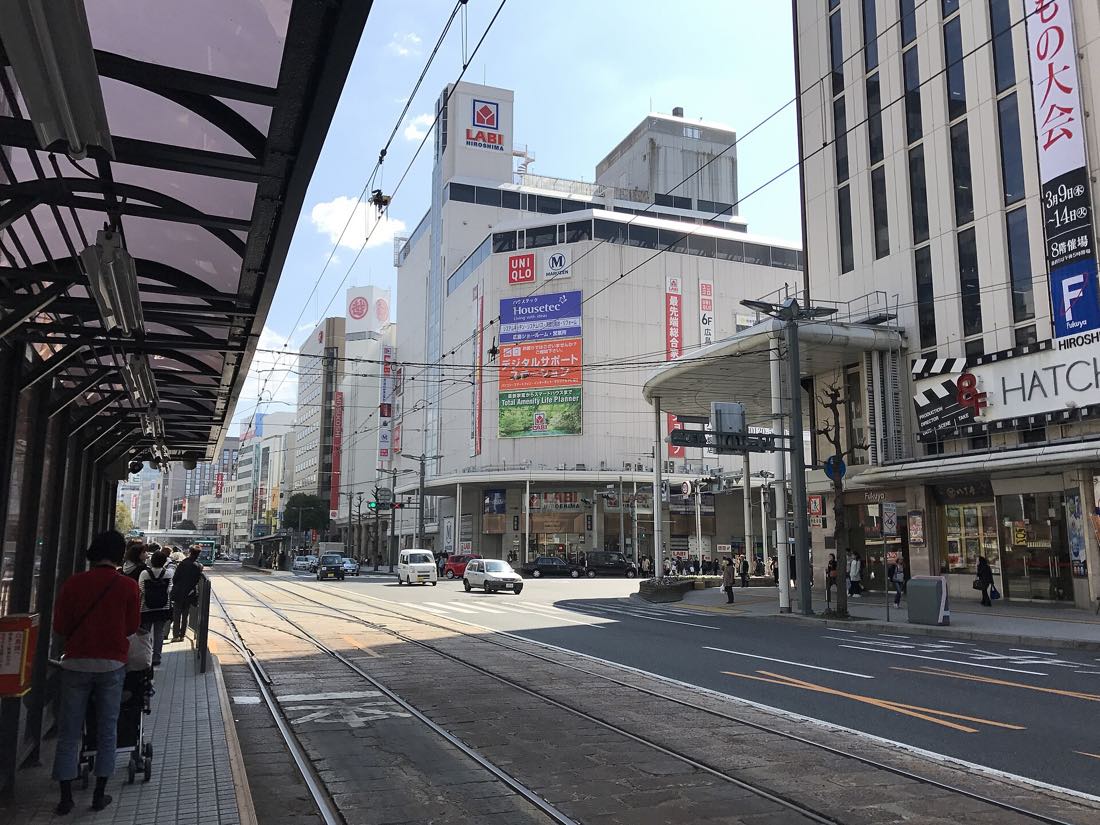
Hatchobori,
where the city stays up.
If the Peace Park is why you came, Hatchobori is where you spend the evening. It is the retail and drinking core of the rebuilt city, it holds the covered arcade that saves a rainy afternoon, and it sits on the one tram junction where four Hiroden lines meet.
Hatchobori is the department-store and nightlife district immediately east of the Hondori arcade, and it is the interchange for Hiroden lines 1, 2, 6 and 9 — no other stop in Hiroshima reaches as much at the flat ¥240 fare. The Peace Park is about 10 minutes by tram or 20 on foot, Hiroshima Station about 10 minutes, and Nagarekawa, the bar quarter, is a two-minute walk south. Rooms run around ¥9,500 for a business 3-star plus a ¥200 per person per night prefectural accommodation tax you pay at the desk, and this is the one part of the city that is still busy at 23:00.
The commercial half of the centre
What it isHatchobori, Hondori, Shintenchi and Nagarekawa are four names for a single block of the city that runs roughly ten minutes end to end. Between them they hold the department stores, the arcade, the okonomiyaki, the karaoke and almost every bar a visitor will find.
Hiroshima is a comfortable, well-run, entirely ordinary mid-size Japanese city. The bomb took the old fabric and the rebuild was practical rather than picturesque. Come for the Peace Park, the island and the food — not for the streetscapes. The mistake almost everyone makes is giving the important part four hours and the ordinary part none.
Hondori is the covered arcade — about 500 metres of roofed shopping street running west towards the Peace Park, and the correct answer to a wet afternoon in a city that gets 279.8mm of rain in an average July, its wettest month. Hatchobori proper is its eastern end, where the department stores and the tram junction are. Shintenchi and Nagarekawa sit immediately south, and that is where the evening happens: standing bars, izakaya, karaoke boxes and Okonomimura, the building of stacked okonomiyaki stalls.
The reason to care about the geography is the tram. Hatchobori is where Hiroden lines 1, 2, 6 and 9 cross, which means you can reach the Peace Park, Hiroshima Station, Shukkeien and Miyajimaguchi from one stop without changing. At a flat ¥240 a ride that is worth more than it sounds — it is the difference between a ¥700 day pass paying for itself and not.
What one tram junction reaches
From this stopEvery line below leaves from Hatchobori at the flat ¥240 adult fare, ¥120 child. This is the strongest single argument for sleeping here.
| Destination | Line | Time | Fare |
|---|---|---|---|
| Genbaku Dome-mae (Peace Park) | Hiroden 2 or 6 | ~8 min | ¥240 |
| Hiroshima Station | Hiroden 1, 2 or 6 | ~10 min | ¥240 |
| Shukkeien-mae | Hiroden 9 | ~4 min | ¥240 |
| Hiroshima Castle (Kamiyacho area, then walk) | Hiroden 1, 2 or 6 + ~10 min on foot | ~12 min | ¥240 |
| Miyajimaguchi | Hiroden 2, through-running | ~65–75 min | ¥240 flat, cut from ¥270 in February 2025. JR is ¥420 but takes 27 min |
| Hondori arcade | On foot | ~5 min | Free |
| Nagarekawa bars | On foot | ~2 min | Free |
One change to know about: the Meipuru-pu Maple-loop tourist bus no longer stops at Hatchobori or Kamiyacho. Its Orange, Green and Lemon routes were abolished on 18 July 2026 and replaced by a single unified route — ¥240 a ride, ¥600 for a day pass or ¥400 bought online two or more days ahead, free with a JR Pass, running 09:00–18:00 every 10–15 minutes. Several major guides still describe the old colour routes. The trams below are unaffected. Hiroden went to a flat ¥240 adult / ¥120 child fare on 1 February 2025, its first revision in seven years, replacing the old distance-based ¥140–270 scale. The all-day streetcar pass is ¥700, so it pays from your third ride — which is exactly what a Peace Park, castle and station day comes to.
The practical bit
Plan your visitNagarekawa, honestly
The eveningNagarekawa is Hiroshima's entertainment quarter and it behaves like one: a dense grid of small bars, snack bars, karaoke and hostess clubs stacked in narrow buildings, busy from about 20:00 and properly going after 22:00.
Two things are worth knowing before you walk in. First, a large share of the frontage is not aimed at visitors — snack bars and hostess clubs are members-and-regulars places, and the polite move if a door is not obviously open to walk-ins is to keep walking. Second, table charges are normal in Japan and are not a scam; they will be posted, and they are one reason we do not publish bar prices we have not verified.
The straightforward version is the standing bars and izakaya on the main streets, plus a proper okonomiyaki counter. Hiroshima okonomiyaki is layered rather than mixed and has noodles in it, which is the entire difference from the Osaka style — the dish, explained. Locals eat at standalone counters like Nagataya, Micchan and Hassei rather than at Okonomimura, which is genuinely enjoyable and genuinely touristy at the same time.
A guided bar crawl solves the door problem outright, which is the real service it sells rather than the drinks. What is open after dark covers the rest.
Hatchobori against the other places to sleep
CompareIndicative nightly rates — hotel pricing moves daily and we do not publish it as verified.
| Base | Trams | To the Peace Park | Evening | Verdict |
|---|---|---|---|---|
| Hatchobori | Lines 1, 2, 6 and 9 from one stop | ~8 min tram, ~20 min walk | The busiest in the city — bars, karaoke, late kitchens | WORTH IT |
| Naka-ku, park side | Lines 2, 6 nearby | 10–15 min on foot | Quiet after 21:00, which is the point of it | WORTH IT |
| Hiroshima Station | Every line terminates here | ~15 min tram, ¥240 | ekie inside the station, then nothing | WORTH IT |
| Miyajima | Ferry, then the JR line | About an hour away | The island after the last ferry — and roughly twice the room rate | DEPENDS |
All three mainland options are within about fifteen minutes of each other at ¥240 a ride, so this is a preference rather than a mistake you can make. The full breakdown is on where to stay.
Hatchobori and Hondori — the questions people ask
FAQPage schema pairedWhere is the nightlife in Hiroshima?
Nagarekawa and Shintenchi, immediately south of Hatchobori and about a two-minute walk from the tram junction. It gets going around 20:00 and runs late. The Peace Park side of Naka-ku is quiet by 21:00, so if you want an evening out you either sleep here or take a ¥240 tram back.
Is the Hondori arcade worth visiting?
As a shopping street, it is ordinary. As infrastructure it is excellent: roughly 500 metres under cover, running west towards the Peace Park, which makes it the single best answer to rain in a city that averages 131.4mm of it in August. It also connects Hatchobori to the park end on foot in 10–12 minutes.
Where should I stay in Hiroshima for shopping and food?
Hatchobori. It puts the department stores, the arcade, Okonomimura and Nagarekawa within a five-minute walk, and it sits on the interchange for Hiroden lines 1, 2, 6 and 9 — the only stop in the city that reaches the Peace Park, the station and Shukkeien without a change. Rooms run around ¥9,500 plus a ¥200 per person per night prefectural accommodation tax you pay at the desk.
How do you get to Hatchobori from Hiroshima Station?
Hiroden line 1, 2 or 6, about 10 minutes at the flat ¥240 adult fare. If you are making three or more tram rides that day, the ¥700 all-day pass is already ahead — the break-even is exactly three rides.
Is Okonomimura or a standalone counter better?
Okonomimura is a building of around 23 stacked okonomiyaki stalls on floors 2 to 4, and it is both genuinely fun and genuinely touristy — the stalls are real and the location is a magnet. Hours vary by stall and the prefecture's own source declines to publish building-wide opening times, so ignore any page that gives you one. Locals more often eat at standalone counters such as Nagataya, Micchan and Hassei. Prices are not verified on this site; counters post their own.
Is Nagarekawa safe for visitors?
Yes, in the ordinary Japanese sense — it gets going around 20:00 and runs late. The thing to understand is not danger but custom: a proportion of the doors are snack bars and hostess clubs that operate on regulars, table charges are normal and posted, and the polite move at any door that is not obviously open to walk-ins is to keep walking. A guided bar crawl removes that problem entirely.
How far is Hatchobori from the Peace Memorial Park?
About 8 minutes on Hiroden line 2 or 6 to Genbaku Dome-mae at ¥240, or roughly 20 minutes on foot through the Hondori arcade — which is flat, covered and the more pleasant of the two when the weather is bad.
What is there to do in Hatchobori during the day?
Department stores, the 500-metre covered arcade, and the walk west to the Peace Park. It is not a sightseeing district — the honest use of a Hatchobori afternoon is rain cover, souvenir shopping and an early okonomiyaki. For an actual daytime plan, see things to do in Hiroshima.
Booking and getting there
PracticalA bed on the interchange and a guided version of the evening, which mostly buys you the doors you would not otherwise open.