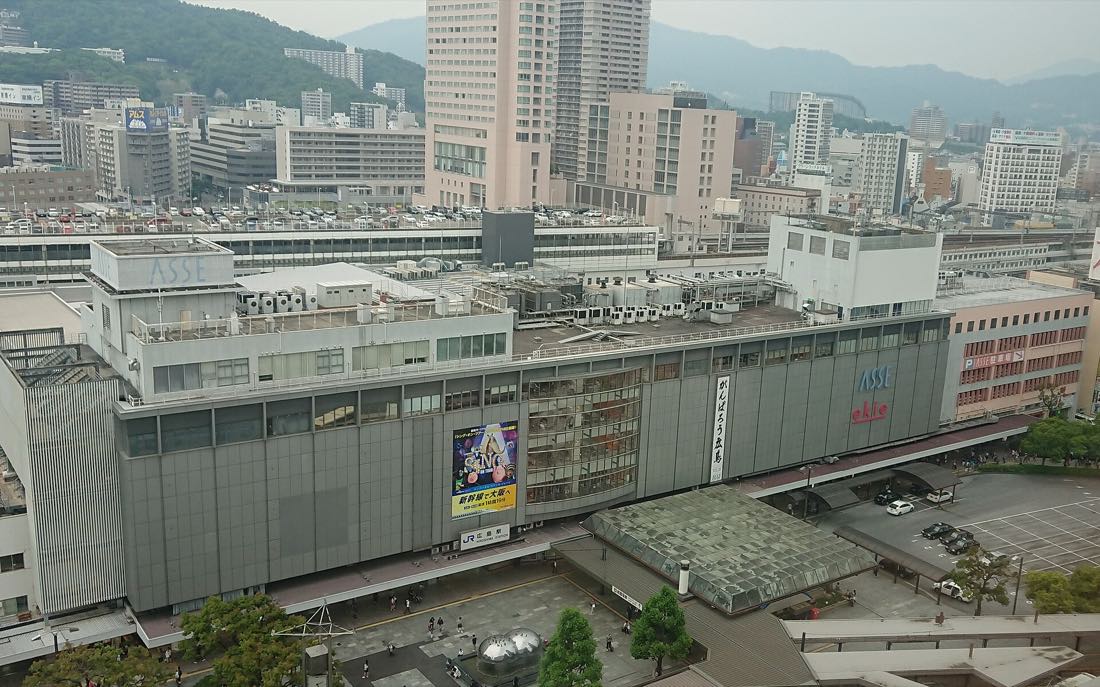
Hiroshima Station,
and why you sleep here.
This is not the pretty part of Hiroshima and nobody claims otherwise. It is where the shinkansen lands, where the trams and the airport bus and the Miyajima line all start, where the lockers are, and where the cheapest reliable beds in the city sit. On a two-day trip that combination beats charm.
Sleep here if you are arriving or leaving by shinkansen, doing a day trip, or travelling with luggage. A solid business 3-star runs about ¥9,500 (~$60) a night and Hiroshima Prefecture adds a ¥200 per person per night prefectural accommodation tax you pay at the desk. The Peace Park is Hiroden line 2 or 6 to Genbaku Dome-mae, about 15 minutes at the flat ¥240 fare, or roughly 17 minutes on the Meipuru-pu loop bus, which is free with a JR Pass. The trade-off is that the area empties after dinner — the nightlife is two tram stops away at Hatchobori.
An interchange with hotels attached
What it isHiroshima Station is the Sanyo shinkansen stop, the JR local hub for Miyajimaguchi and Kure, the Hiroden streetcar terminus, the airport bus stand and the start of the Meipuru-pu tourist loop. Everything you will do in this city begins by leaving from here.
Hiroshima is a comfortable, well-run, entirely ordinary mid-size Japanese city. The bomb took the old fabric and the rebuild was practical rather than picturesque. Come for the Peace Park, the island and the food — not for the streetscapes. The mistake almost everyone makes is giving the important part four hours and the ordinary part none.
The station itself has been rebuilt in stages over the last decade, and the retail complex inside it — ekie — is genuinely useful rather than a consolation prize: okonomiyaki counters, souvenir floors, convenience stores and enough food to cover a 06:30 departure or a 22:00 arrival. It is the answer to "where do I eat when everything else has shut", which on a rail-heavy trip is a question you will ask.
The area splits into two sides. The south exit is the older, denser side facing the city — trams, Hiroden's terminus, and most of the business hotels. The north (shinkansen) exit is quieter, with the Shinkansen-guchi hotels and the walk to Mazda Zoom-Zoom Stadium, home of the Carp, about ten minutes away. Neither side is scenic. Both are about fifteen minutes from the Peace Park.
The tram terminal moved inside the station — and every older guide is now wrong
The 2025 rebuildOn 3 August 2025 Hiroden's terminus moved off the street and onto the second floor of the JR station building, level with the JR central ticket gate. Trams now arrive over a new 1.1km viaduct. It is the first tram terminal inside a station building at this level anywhere in Japan.
The practical consequences are larger than they sound. The JR-to-tram transfer fell from about 2.1 minutes to about 1.3, it is now flat and step-free rather than a street crossing, and the run to Hatchobori and Kamiyacho is roughly four minutes faster. The vertical layout is what to hold in your head: Shinkansen on 3F, JR conventional lines and the trams on 2F. Arriving by shinkansen you go down one level to the trams, not out to the street.
Any route description written before August 2025 is wrong, and most of the pages ranking for this station still are. The Saruko-bashi-cho stop was abolished in the rebuild and the stop numbering changed across the network, so a memorised stop number from an older guide will not match what is on the platform. One more recent change worth knowing: since 28 March 2026 the Hondori stop carries the official subtitle 「平和記念公園東」, "Peace Memorial Park East", added specifically because visitors could not find the park from the tram map.
Hiroden went to a flat ¥240 adult / ¥120 child fare on 1 February 2025, its first revision in seven years, replacing the old distance-based ¥140–270 scale. The all-day streetcar pass is ¥700, so it pays from your third ride — which is exactly what a Peace Park, castle and station day comes to.
The station building's own retail complex, minamoa, opened fully on 24 March 2025 with around 220 shops, which is on top of the older ekie floors. Getting around Hiroshima has the lines, the IC-card situation — Suica and ICOCA still work through simplified readers, PiTaPa was dropped, and you cannot top up on board — and the one thing to remember at the door: you pay on exit.
The practical bit
Plan your visitStation area against the other places to sleep
CompareFour bases, and the honest reason to pick each. Nightly rates are indicative rather than verified — hotel pricing moves daily.
| Base | Best for | To the Peace Park | Evening | Verdict |
|---|---|---|---|---|
| Hiroshima Station | Rail arrivals, day trips, luggage, early starts | ~15 min, Hiroden line 2 or 6, ¥240 | Quiet — ekie inside the station, then not much | WORTH IT |
| Naka-ku, by the park | Walking to the museum, the 7:30 opening, riverbanks | 0–15 minutes on foot | Quieter than Hatchobori and that is the point | WORTH IT |
| Hatchobori and Hondori | Shopping, eating, drinking, the best tram interchange | ~10 min tram or ~20 min walk | The busiest evening in the city — Nagarekawa is here | WORTH IT |
| Miyajima island | The island after the last ferry | About an hour and a ferry away | The whole reason to do it — and roughly twice the price | DEPENDS |
There is no wrong answer among the first three; the city is small and the tram is flat-fare. Full breakdown on where to stay in Hiroshima. Dollar prices convert at ¥157.7 = $1, the rate on 4 August 2026. Treat every $ figure as a snapshot and the ¥ figure as the real price.
What sleeping here costs you
The honest downsideAtmosphere, and about fifteen minutes twice a day. The station district is a working interchange: office blocks, chain restaurants, bus lanes and hotel lobbies. Nobody walks around it in the evening for pleasure, and if your idea of a good night is stepping out of the lobby into something, this is not that.
It also puts you the wrong side of the city for the one thing worth doing after dark — the A-Bomb Dome floodlit, which needs a ¥240 tram each way at 19:30. That is trivial, but it is the difference between doing it and meaning to. If you are here for one night and one night only, and the Peace Park is the reason, Naka-ku is the better bed.
For everyone else — two-day trips, rail passes, day trips to Kure or Iwakuni, and anyone with a suitcase — the station wins on the arithmetic. It is also the right base if you are attempting a day trip from Kansai and decided at the last minute to stay over.
Hiroshima Station area — the questions people ask
FAQPage schema pairedIs it better to stay near Hiroshima Station or the Peace Park?
Station for logistics, Peace Park for the visit itself. The two are 15 minutes and ¥240 apart on Hiroden line 2 or 6, so the decision is small. Stay by the station if you are doing day trips or carrying luggage; stay in Naka-ku if you want to walk to the museum's 7:30 opening in ten minutes.
How do you get from Hiroshima Station to the Peace Memorial Park?
Hiroden line 2 or 6 to Genbaku Dome-mae, about 15 minutes at the flat ¥240 adult fare. The Meipuru-pu loop bus takes about 17 minutes and is covered by the JR Pass, which makes it free if you already hold one. Walking takes about 45–50 minutes and is not worth it.
Are there coin lockers at Hiroshima Station?
There are, but here is the honest version: no official source publishes locker sizes or prices anywhere in Hiroshima, so any site quoting them is guessing. What is verified are the two staffed counters at the station — Tours Hiroshima at ¥500 per item of any size, 8:30–18:00, and Crosta Hiroshima at ¥800, or ¥1,000 oversize, 9:00–20:00, with hotel delivery at ¥1,500. On a tight connection, pay the ¥500 rather than hunt. More on the practical page.
What is ekie at Hiroshima Station?
The retail and dining complex built into the station — okonomiyaki counters, souvenir floors, convenience stores and food that is open when the rest of the city is not. It is the reason a 22:00 arrival is not a problem here, and worth 30 minutes on the way out for omiyage.
Is the Hiroshima Station area a good place to stay?
Yes, on the arithmetic. Business 3-stars run around ¥9,500 a night, the prefecture levies a ¥200 per person per night prefectural accommodation tax you pay at the desk, and every train, tram, airport bus and day trip starts within a few minutes' walk. The cost is atmosphere: the district empties after dinner and the nightlife is two tram stops away at Hatchobori.
How far is Hiroshima Station from Miyajima?
¥420 and 27 minutes on the JR Sanyo line to Miyajimaguchi, then a 10-minute ferry at ¥200 each way plus the ¥100 per-person visitor tax. Rail-pass holders still pay the ¥100 tax separately at the terminal — the pass covers the JR ferry but not the levy. Every route is on getting to Miyajima.
Is Hiroshima Station near the Carp stadium?
Yes — Mazda Zoom-Zoom Stadium is about a 10-minute walk from the north side of the station, which makes a home game the easiest evening in the city when the NPB season is running from late March to October. We have not verified ticket prices; the club publishes the fixture list.
Do I need a tram pass if I stay by the station?
Only if you make three or more rides in a day. The flat fare is ¥240 and the all-day pass is ¥700, so the break-even is exactly three — which a Peace Park, castle and station day hits, and a single evening out does not.
Booking and getting there
PracticalThe station district's whole argument is price and convenience, so this is a price-and-convenience search rather than a curated list.