Hiroshima as a day trip
from Kyoto or Osaka.
Thousands of people do this every week and the trains make it easy. The problem is not the travelling. The problem is that you arrive with the crowds, you get about five hours on the ground, and you leave before the museum has done its work — which is the one thing the trip was for. Both ends of that ride are covered — thingstodoosaka.com and thingstodokyoto.com.
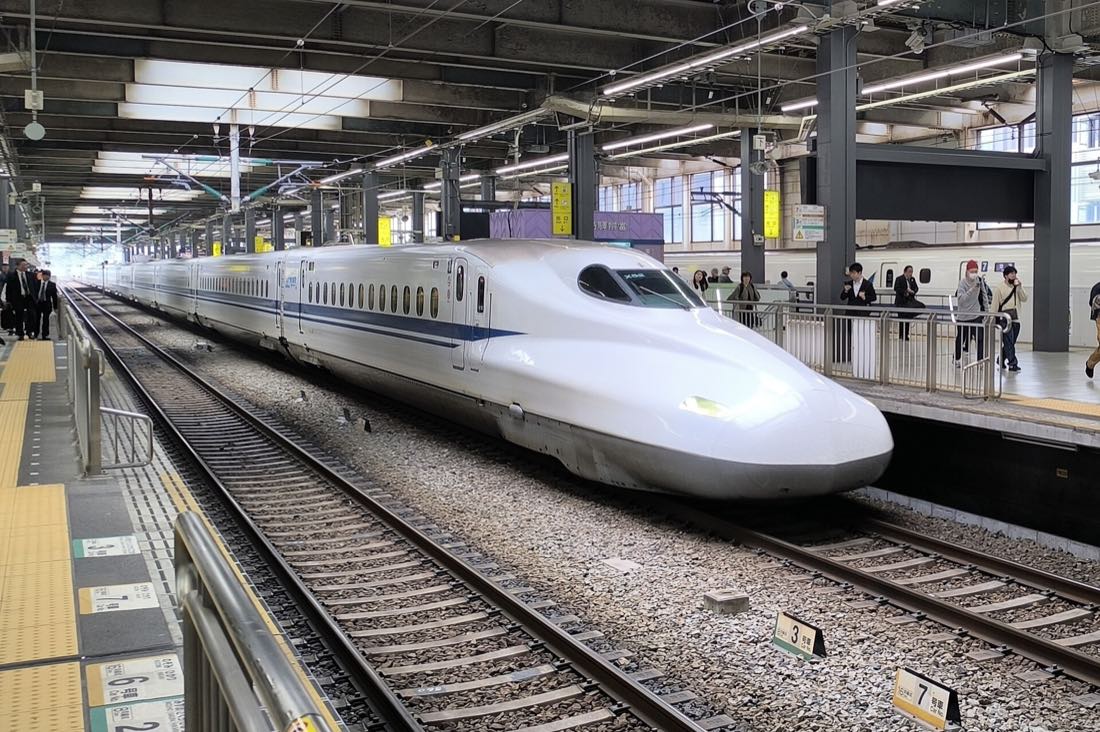
Stay one night. The trip itself is genuinely easy — Shin-Osaka to Hiroshima is 1h20–1h29 on a Nozomi and ¥9,890 unreserved, with Kyoto adding about 15–20 minutes — and that is exactly why the day trip is tempting and exactly why it costs you the museum. A single night turns a compressed six-hour visit into the 7:30 museum opening, the floodlit Dome after dark and a proper okonomiyaki dinner, at roughly ¥9,500 for a business 3-star plus a ¥200 per person per night prefectural accommodation tax you pay at the desk. If your dates cannot move, leave Kansai before 07:00, give the museum two hours and accept that Miyajima is not happening. Nozomi is not covered by the JR Pass, and the supplement is not a discount — it is the section's full unreserved limited-express charge, ¥4,170 from Shin-Osaka.
It works, and it costs you the thing you came for
The honest answerA Hiroshima day trip from Kansai is not a logistical problem. The Sanyo shinkansen runs frequently, the Peace Park is 15 minutes from the station on Hiroden line 2 or 6 at a flat ¥240, and you can be standing at the Cenotaph before eleven. It is an editorial problem.
Allow two hours in the Peace Memorial Museum, three if you read properly, and leave the two hours after it empty. At peak you don't walk the exhibition so much as get carried through it — during Obon last year staff had to stop admissions entirely. Everyone who budgeted 45 minutes regrets it.
A day-tripper from Kyoto or Osaka arrives around 10:00 and has to leave around 16:30 to be back for dinner. That is roughly six and a half hours in the city, of which the museum needs two and the outdoor monuments an hour. It fits — barely — but you arrive precisely inside the 11:00–14:00 block, which is the worst three hours of the day at the museum and the hours when pre-booked entry is the only entry. You will do the most important building in the city shoulder to shoulder with a coach group, and then get on a train.
From 8 to 16 August 2026 the Peace Memorial Museum takes no walk-ups at all: online reservation only, capped at 1,000 people an hour, released 90 days ahead. Outside that window the 11:00–14:00 block is pre-booked entry only. The museum opens at 7:30 and almost nobody uses it.
What a single night adds is not more sights. It is the 7:30 opening with the exhibition close to empty, the two hours afterwards to not do anything, the Dome floodlit, and dinner at a counter. Hiroshima is one of the cheapest overnight stops on the whole Sanyo line, which is what makes the trade so lopsided. If your itinerary can absorb one night, absorb it — how many days you need makes the fuller case.
Hiroshima is a comfortable, well-run, entirely ordinary mid-size Japanese city. The bomb took the old fabric and the rebuild was practical rather than picturesque. Come for the Peace Park, the island and the food — not for the streetscapes. The mistake almost everyone makes is giving the important part four hours and the ordinary part none.
Every shinkansen option, priced
Getting thereFares are one-way per adult and were verified on 4 August 2026. Kyoto is not a separate row because it sits about 15–20 minutes further out than Shin-Osaka on the same trains — use the Shin-Osaka figures as your anchor and add the difference.
| From | Train | Journey | Fare | On a JR Pass? |
|---|---|---|---|---|
| Shin-Osaka | Nozomi / Mizuho | 1h20–1h29 | ¥9,890 unreserved · ¥10,950 reserved | No — Nozomi and Mizuho are excluded |
| Shin-Osaka | Sakura / Hikari | 1h28–1h31 | ¥9,890 unreserved · ¥10,420 reserved | Yes |
| Shin-Osaka | Kodama | 2h13–2h35 | ¥9,890 unreserved · ¥10,420 reserved | Yes |
| Kyoto | Nozomi | ~1h40–2h | Adds roughly 15–20 minutes and the corresponding fare step to the Shin-Osaka figures | No |
| Tokyo | Nozomi | 3h49, direct | ¥18,380 unreserved · ¥19,760 reserved | No |
| Tokyo | Hikari / Sakura | ~5 hours — there is no direct Hikari, pass holders change at Shin-Osaka | ¥18,380 unreserved · ¥18,910 reserved | Yes, with the change |
Two traps. The Nozomi supplement is not a discount — a pass holder who wants to ride one pays the section's full unreserved limited-express charge again: ¥4,170 from Shin-Osaka, ¥6,500 from Tokyo. And JR abolished its 10% round-trip discount on 14 March 2026, so every online Tokyo–Hiroshima cost comparison written before then is roughly ¥2,380 too low. Dollar prices convert at ¥157.7 = $1, the rate on 4 August 2026. Treat every $ figure as a snapshot and the ¥ figure as the real price.
The national JR Pass loses on this trip
The pass mathsFor a Kansai-based traveller adding one Hiroshima day, the 7-day national pass is close to the worst purchase available — and the numbers are not close.
A Tokyo–Hiroshima return in cash is ¥36,760–39,520 against ¥50,000 for a 7-day ordinary pass: you lose ¥10,480–13,240. Riding Nozomi on top of the pass costs about ¥63,000 all in, which is ¥23,480 more than simply buying Nozomi tickets. From Osaka or Kyoto the gap is wider still, because the journey is under 90 minutes each way.
The pass that does win is the Kansai–Hiroshima Area Pass at ¥17,000 for 5 days — less than a cash Osaka–Hiroshima shinkansen return, and it includes the JR Miyajima ferry. The JR Setouchi Area Pass at ¥22,000 is the wider-area alternative. Work both against your actual route on the JR Pass page and Setouchi versus JR Pass.
One piece of timing worth knowing if you are buying a national pass anyway: the 1 October 2026 rise — 7-day ¥50,000 to ¥53,000, 14-day ¥80,000 to ¥84,000, 21-day ¥100,000 to ¥105,000 — applies to overseas agents and retailers, while the official JR Pass website is holding current prices "for the time being". From 1 October, buying direct saves ¥3,000–5,000. Do not assume that lasts.
⚠ One scheduling warning: Nozomi typically runs 100% reserved during Obon and New Year, so do not plan on walking onto an unreserved car between 7 and 16 August.
The best possible version of the day trip
If you are going anywayBe on an early train, not a civilised one
Shin-Osaka to Hiroshima is 1h20–1h29 on a Nozomi at ¥9,890 unreserved; Kyoto adds about 15–20 minutes. Every hour you leave later comes off the far end, and the far end is where the museum sits. Reserve the day before if you can — 5–7 August seats go within days of release, and Nozomi runs 100% reserved over Obon and New Year.
Hiroshima Station — lockers first
Coin lockers and the ekie complex are inside the station. Drop your bag before you do anything else; carrying it around the park costs you the museum's own lockers later. The station area page has the layout.
Hiroden line 2 or 6 to Genbaku Dome-mae
Flat ¥240 (~$1.50), about 15 minutes. The Meipuru-pu loop bus takes about 17 minutes and is free with a JR Pass, which is the one genuine pass perk on this trip. A day pass at ¥700 only pays from your third ride and a day-tripper usually takes two.
The Peace Memorial Museum
¥200 (~$1.27). Give it two hours and do not negotiate with yourself about it — this is the reason you got up at five. Pre-book if your date falls between 8 and 16 August, when walk-ups are refused entirely. The museum page.
The Cenotaph, the Flame, the Children's Peace Monument, the Dome
Free and always open, about 17 minutes of walking between the four. Stand at the Cenotaph and look through the arch first — the whole park is laid out on that sightline. The full circuit.
The free English testimony talk — if you can make it fit
13:00–14:00 daily in the museum's East Building, Basement 1. Free, in English, no reservation, 60 minutes including questions. On a day trip this competes directly with lunch, and it should win. Why.
Okonomiyaki, 10 minutes' walk away
Layered rather than mixed, with noodles in it. Okonomimura is the quickest option from the park; the standalone counters locals use are Nagataya, Micchan and Hassei. Restaurant prices are not verified on this site.
One optional extra — and not the castle
Hiroshima Castle's keep closed permanently on 22 March 2026, so do not walk 20 minutes for a view that no longer exists. Better uses of 45 minutes: Shukkeien at ¥350, Orizuru Tower across from the Dome at ¥2,200 plus a ¥100 paper-crane fee, 10:00–18:00 with last entry 17:30, or the arcade at Hondori.
Back to the station and out
Line 1, 2 or 6 back, ¥240, about 15 minutes. If you can move your return by two hours you get the Dome floodlit, which is the one thing on this page that would make a day trip feel finished.
Miyajima is not part of a Kansai day trip
The thing that does not fitSeveral operators sell Hiroshima and Miyajima in one day from Kyoto or Osaka. It is a real product and people enjoy it. What it is not is a version of this trip with the museum in it.
The island alone needs three hours to justify the crossing, plus 27 minutes each way on the JR Sanyo line from Hiroshima and a 10-minute ferry at ¥200 each way with a ¥100 visitor tax on top. Bolt that onto a Kansai round trip and the museum gets 45 minutes, or it gets skipped and replaced with a photograph of the Dome from the bridge.
Miyajima runs on the tide, not the clock. Above 250cm the Great Torii appears to float and the shrine's corridors stand over water; below 100cm you can walk out across the sand to the gate's legs. Those are the Miyajima Tourist Association's own published thresholds, and they are measured against the Hiroshima Port datum — 200cm below mean sea level — so a generic tide app will give you numbers that look similar and are not comparable. Check the official table before you book the ferry, not after.
There is also a timing problem nobody mentions: a packaged day trip cannot move its ferry to suit your tide. If the water is in the flat middle band on your date — roughly 100cm to 250cm — you get wet sand, no reflection and a gate you cannot walk to, and no guide can fix that. Check the tide table for your date before you book any combined product, and if the tide is wrong, drop the island rather than the museum.
Hiroshima from Kyoto or Osaka — the questions people ask
FAQPage schema pairedCan you do Hiroshima as a day trip from Kyoto?
Yes, and easily — Kyoto to Hiroshima is about 1h40–2h by Nozomi, roughly 15–20 minutes more than the 1h20–1h29 from Shin-Osaka, which is ¥9,890 unreserved. The cost is time on the ground: leave before 07:00 and you get about six and a half hours in the city, of which the museum needs two and the outdoor monuments an hour. The constraint is the schedule, not the railway.
Can you do Hiroshima as a day trip from Osaka?
Yes, and Osaka is the easier of the two: Shin-Osaka to Hiroshima is 1h20–1h29 on a Nozomi, ¥9,890 unreserved or ¥10,950 reserved. The same arithmetic applies at the far end: about six hours on the ground, a two-hour museum floor, and no realistic room for Miyajima. Stay one night if your itinerary can take it — a Hiroshima business 3-star runs about ¥9,500 plus a ¥200 per person per night prefectural accommodation tax you pay at the desk.
Is Hiroshima worth a day trip from Kyoto or Osaka?
It is worth going. It is not worth going for four hours. The single most common mistake on this trip is budgeting 45 minutes for the Peace Memorial Museum, which is a two-hour building minimum and three if you read properly. Do the museum well and cut something else.
Is the Nozomi covered by the JR Pass to Hiroshima?
No — Nozomi and Mizuho are excluded, and the supplement is not a discount: it equals the section's full unreserved limited-express charge, ¥4,170 from Shin-Osaka and ¥6,500 from Tokyo. Worse, from Tokyo there is no direct Hikari, so pass holders change at Shin-Osaka and take about 5 hours against Nozomi's 3h49. A Tokyo–Hiroshima return in cash is ¥36,760–39,520 against ¥50,000 for the pass.
How long do you need in Hiroshima on a day trip?
Six hours on the ground is the working minimum: 15 minutes each way on Hiroden line 2 or 6 at ¥240, two hours in the museum, an hour on the monuments, an hour for lunch and the 13:00 English testimony talk. Under five hours you are choosing between the museum and everything else.
Can you do Hiroshima and Miyajima in one day from Kyoto?
Operators sell it, and it works only by cutting the museum. Miyajima needs three hours plus 27 minutes each way from Hiroshima and a 10-minute ¥200 ferry with a ¥100 visitor tax. Add a Kansai round trip and something has to go — pick the island or the museum deliberately rather than discovering the choice at 14:00.
How much does a Hiroshima day trip cost?
The rail leg is the whole cost: ¥9,890 unreserved each way from Shin-Osaka, about ¥19,780 return, or ¥18,380 each way from Tokyo. On the ground it is trivial — ¥200 for the museum, ¥480 for two tram rides at the flat ¥240 fare, and lunch. Before buying any pass, note that the ¥17,000 Kansai–Hiroshima Area Pass costs less than a cash Osaka return and includes the JR Miyajima ferry.
Is a guided day trip from Kansai worth booking?
It is worth it if you would otherwise spend the day watching a clock — the operator owns the seats, the timings and the walk order, which matters when the train is only 1h20–1h29 each way from Shin-Osaka and the day on the ground is about 6 hours. We do not publish GetYourGuide prices, star ratings or review counts because we could not verify them; compare what each listing actually includes, especially whether museum entry is covered or the tour stops at the door.
Guided day trips from Kyoto and Osaka
Book itThe packaged versions, where the operator owns the train seats and the walking order. We do not publish prices, ratings or review counts for these — none could be verified — so compare inclusions instead, starting with whether museum entry is in the price.